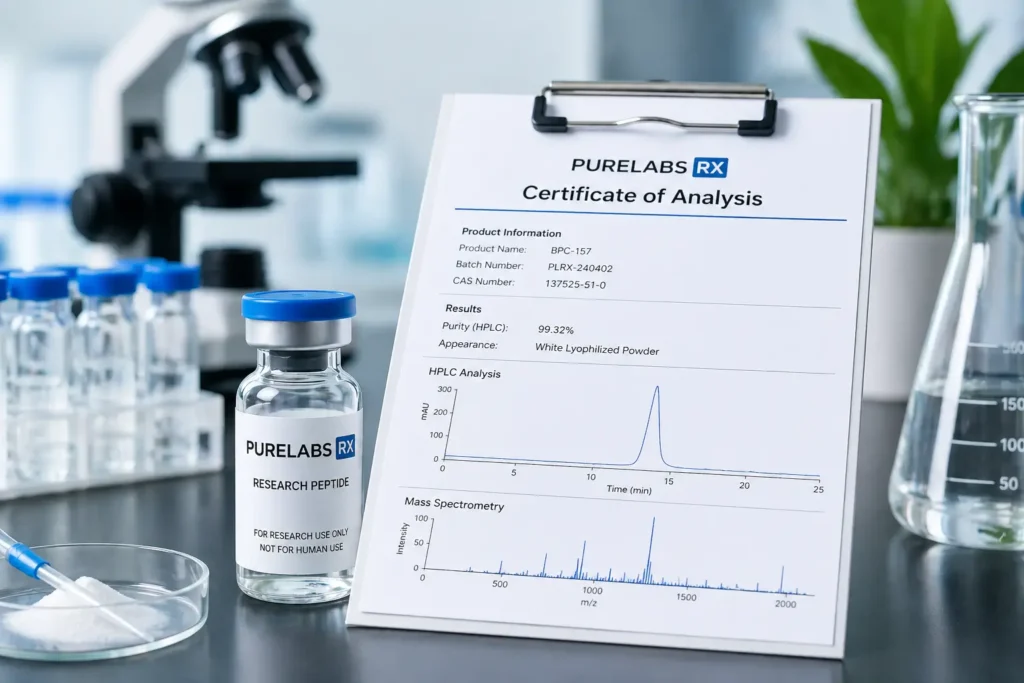
How To Read A Peptide Coa Real Vs Fake
How To Read A Peptide Coa Real Vs Phony Notably, this pureness number is generally identified after filtration (e.g. Exercise Physiology by HPLC) and concentrates on peptide pollutants-- it does not count residual water, salts, or counter-ions in the dried out peptide powder. Simply put, the purity percentage is about the structure of peptide species in the sample, not the weight contribution of water or salts. If you have actually ever before gotten a synthetic peptide for a lab experiment, you have actually most likely saw a pureness percent on the certificate of analysis-- generally values like 95%, 98%, or perhaps 99%. Peptide pureness is an important quality metric that tells you what fraction of a peptide sample is the intended item versus undesirable by-products. In simple terms, a peptide detailed as 95% pure consists primarily of the target peptide (95%), with the continuing to be ~ 5% made up of impurities. These impurities can consist of points like shortened or truncated series, deletion versions, oxidized deposits, or other small side-products from the synthesis procedure. A strong test record can support pureness, identification, and set traceability. It does not turn a study substance into a professional item, and it does not replace speculative validation in the researcher's very own system. The peptide sample is dissolved in a compatible solvent and packed right into an autosampler. The injector presents an accurate quantity of sample into the mobile-phase stream.
Full List Of The Top 100 Peptide Suppliers
Top-tier laboratories commonly report peptide purity well above 95%, often ≥ 98-99%, by using modern HPLC and MS evaluations. They likewise examine both raw materials and completed peptide vials, which helps capture any kind of contaminations, deterioration products, or formulation disparities. This degree of detailed evaluation guarantees the peptide's precision-- indicating the series and purity are exactly as classified-- which is critical for experimental reproducibility. By verifying make-up through multiple confirmed techniques, laboratory validation assurances that researchers receive a high-purity peptide that will perform as expected in the lab. Relied on labs employ proven testing protocols to analyze peptide examples and confirm their pureness and chemical structure.Where can I send my peptides to check for pureness?
ACS Peptide Checking Labs is a professional peptide evaluation lab that approves samples from all 50 states. Whether you need to examine peptide purity, validate a provider''s Certification of Evaluation, or run detailed contaminant screening, our lab offers quickly, accurate outcomes with thorough reporting.
What A Coa Can Not Tell You (Crucial For Study Preparation)
Yet these COAs commonly originate from the vendor's own screening, developing a noticeable dispute of rate of interest. Also when vendors claim third-party testing, verifying those insurance claims requires initiative most customers don't make. Scientists usually examine mass spectrometry results alongside HPLC data to develop a much more total understanding of product top quality. As the research peptide market continues to grow, recognizing just how peptide pureness screening works can help researchers make more enlightened sourcing choices and much better review provider transparency. Impurities aren't simply inactive fillers; they can actively disrupt your job. Organizations purchasing wholesale research peptides frequently focus on consistency and high quality verification. High-Performance Fluid Chromatography separates substances within a sample to aid recognize and measure specific elements. Shows that most of the analyzed example TB-500 contains the designated peptide substance. Researchers often evaluate purity results as component of a more comprehensive quality-control process. Message us straight on WhatsApp for any kind of questions about our testing process or products.- Scientist frequently reference Janoshik testing when evaluating new vendors or confirming claims.
- Peptides in microspheres and nanoparticles may entangle with matrices, making it tough to separate cost-free and encapsulated types.
- This implies that the synthesis itself must be maximized to guarantee the appropriate molecular species are manufactured to adequately high degrees and/or the levels of inaccurate, problematic series are decreased.
- The purity number requires approach context and sustaining output, such as HPLC chromatograms and identity verification by MS, connected to a batch-specific COA.
- This is why longer peptides are more difficult to generate at high purity and generally cost more.